Mr. Chin is recipient to 5 awards from the U.S. Department of Energy. In 2023, he was Baker Hughes' nominee to the U.S. National Academy of Engineering. Stratamagnetic Software LLC (1997) has provided math modeling and simulation services to companies worldwide. In 2024, Mr. Chin founded Hong Kong's iSyringe Imaging Technologies Limited to develop a novel medical imaging instrument. Advanced aerodyamic design methods for Sixth Generation bombers and drones, developed over two decades and summarized here, are now offered to the aerospace community. Mr. Chin's books, available from www.amazon.com, www.wiley.com and www.elsevier.com, describe test methods, math models and numerical algorithms in detail. Contact the author at stratamagnetic.software@outlook.com, or phone (832) 483-6899 in the United States or +86 133-6625-0233 in the Hong Kong and China region.
Technology You Can Use.
Software downloads, state-of-the-art, reliable and affordable, used internationally and now available to you. Nurture your own ideas with our help. Get published. Deliver talks. Win proposals. Copyright (C) 2026, by Stratamagnetic Software, LLC. All rights reserved.
 Wilson C. Chin, author, scientist and software developer, earned his Ph.D. from M.I.T. and M.Sc. at Caltech. He has published 30 books, 50 patents and 100 papers. His petroleum geoscience interests focus on MWD design, managed pressure drilling, reservoir engineering, formation testing, electromagnetic logging, and drilling and cementing rheology. Wilson's work in advanced aerodynamics, computational biology and medical imaging have attracted strong interest and venture capital awards.
About Us
Home |
Team Members |
Papers |
Patents |
Books |
Brochures |
Contact |
Research, Science and Engineering
Home |
Measurement While Drilling |
Formation Testing |
Fluid Rheology |
Managed Pressure Drilling |
Reservoir Engineering |
Electromagnetic Modeling |
Waves and Vibrations |
Aerodynamics |
Biomedical Imaging |
RECENT BOOKS
All techniques, methods and algorithms in our publications are developed for the general public interest and are not subject to patent restrictions unless noted otherwise. Comments, questions and contributions from all readers are welcome.
 Advanced Aerodynamic Models for Sixth Generation Aircraft Design. Modern bombers and drones fly with delta and lambda planforms, blended fuselages and flapless wings in ground proximity to avoid detection. Transonic flows are common with strong background shears over land, on aircraft carrier take-off or landing. Euler and Navier-Stokes methods are non-standard, slow and inaccurate.
 Multiprobe Pressure Testing and Reservoir Characterization (Wiley, 2024). In the early 1990s, a novel formation tester introduced by a major oil service company was innovative in two respects. The tool, consisting of an active "sink" probe and a passive "horizontal" observation probe displaced azimuthally 180 deg from the sink, would offer predictions for both kh and kv permeabilities. However, at low mobilities, pressure drops at the latter were significantly less than those at the sink. The same was true for the "vertical" probe, located several feet away, coincident with the sink azimuth. These limitations reduced the versatility and usefulness of the multiprobe design, substantially decreasing accuracy behind many tester predictions.
  Biofluids Modeling: Methods, Perspectives and Solutions (Wiley, 2023). Twenty-twenty (2020) was our defining year - Our year of living dangerously. Covid-19 unexpectedly struck. Flights worldwide were cancelled. Borders were shut. Lives were turned upside-down. Deaths mounted. Unpredictability became the only predictable norm. The first author, after one long, long flight, would find himself immobile from "DVT" or "Deep Vein Thrombosis." Not just in one leg, but blood clots in both.
 Quantitative Methods in Reservoir Engineering, Chinese Edition (Elsevier, 2021). Most reservoir flow books provide basic equations like the Darcy equation, single-phase radial solutions, simple well test models, and simplified discussions on relative permeability and capillary pressure. Then elementary concepts on finite differences and modeling are summarized, and commercial simulators and case studies are quickly offered. Unfortunately, many such models are incorrect. The author would develop truly rigorous models that were rapid, stable and simple to use, leading to his 1990 BP Chairman's Innovation Award and several derivative book publications. The present book is a Chinese translation for the Second Edition English book (below) of the same name. It is intended for Chinese language readers, a growing audience given the increasing importance of oil and gas in Asia. For questions and comments, please feel free to contact Xiaoying "Jenny" Zhuang, Asia Marketing Manager.
 Multiprobe Pressure Analysis and Interpretation (Wiley, 2021). Oilfield manufacturers have developed invaluable and versatile dual or multiprobe formation testers consisting of axially displaced pumping and observation probes. Single probe tools pump and measure spherical permeability, while dual probe devices offer kh and kv using data from a single azimuth. In the early 1990s, a multiprobe tester was introduced by a service company that was innovative for its time. This tool, consisting of an active "sink probe" and a passive "horizontal" observation probe displaced 180 deg from the sink would offer kh and kv predictions. However, at low mobilities, measured pressure drops at the latter were significantly less than those at the sink. The same was true for its "vertical" probe, located several feet away. These limitations significantly reduced the tool's usefulness for reservoir characterization.
 Supercharge Invasion and Mudcake Growth in Downhole Applications (Wiley, 2021). This important volume complements COSL's above Multiprobe Pressure Analysis in many ways. These include pressure transient analysis, forward and inverse modeling, supercharge, mudcake growth and fluid invasion formulations, plus contamination and multiphase cleaning methods - and all during the past two decades by the present authors. While China Oilfield Services Limited does manufacture its own conventional single, dual and multiprobe tools, it is the availability of our complete suite of physics-based software models and "Job Planning System" that allows these and its newer generation of formation testers to be used in many more innovative ways. How is supercharge handled in pressure interpretation? What length of time is required before contaminant mud filtrate is absent from collected samples? What is the so-called inverse problem and how is its solution applied in field practice? These questions and many more are considered in the present volume.
 Reservoir Simulation and Well Interference: Parent-Child, Multilateral Well and Fracture Interactions (Wiley, 2020). This volume addresses the most pressing problems confronting modern oil and gas production - well spacing and topology decisions, hydraulic fracturing effects, and challenging transient, 3D real-world simulations performed rapidly using rigorous models.
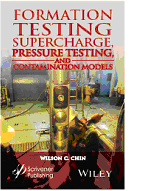 Formation Testing: Supercharge, Pressure Testing and Contamination Models (Wiley, 2019). The Halliburton paper, "A New Hostile Environment Wireline Formation Testing Tool: Case Study from the Gulf of Thailand," by Rourke et al., SPWLA 47th Annual Logging Symposium, Veracruz, Mexico, June 4-7, 2006, cites numerous field examples where overbalance pressures exceed 2,000 psi - not a typographical error.
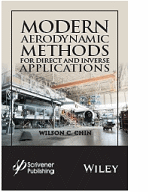 Modern Aerodynamic Methods for Direct and Inverse Applications (Wiley, 2019). An important volume describing modern methods for aerodynamic design in subsonic, transonic and supersonic flow. Special techniques include: (1) Exact drag calculations for nonplanar supersonic bodies, (2) Nonlinear oscillations in low frequency transonic flow, (3) Hydrodynamic stability of shear flows past flexible surfaces, (4) Actuator disk simulation for jet engine power addition, (5) Engine and airframe integration, (6) Type-independent methods for supercritical transonic flow calculation, (7) Shear flow analysis without Euler equation approaches, and more. Importantly, the inverse problem is solved with a new Neumann formulation that rapidly calculates airfoil shapes which induce prescribed pressure distributions. An analogous Kutta-type condition related to opened edges with prescribed mass efflux is introduced in this award-winning book - an important development which will prove useful in flapless wing design for military aircraft in the 2020s time frame.
 Measurement While Drilling: Signal Analysis, Optimization and Design, 2nd Edition (Wiley, 2018). This long awaited update to our best-selling 2014 MWD book takes you behind the scenes, introducing you to the latest developmental efforts at leading international corporations like Sinopec, CNPC, Gyrodata, and GE Oil & Gas. New "out of box" designs are profiled, together with experimental results, and detailed color photographs of prototypes and test fixtures are offered. In particular, we cover high signal strength, rapid self-spinning "sirens in series" that rotate under minimal power, drawing only on the kinetic energy of the flowing mud. We cover miniature, low torque sirens that rotate in narrow conduits, driven by flow rates as low as those from simple hair dryers. We also demonstrate how special rotor tapers can significantly affect siren torque - increasing values so much that jamming is unlikely and trapped debris are rapidly destroyed. Detailed numerical studies are also offered showing how signal reflections from pump pistons and desurgers, and strong mudpump noise, are both effortlessly filtered and removed using cleverly designed transducer arrays and signal processing.
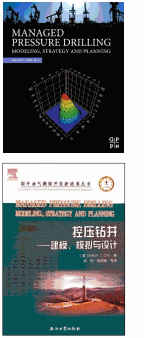 Managed Pressure Drilling: Modeling, Strategy and Planning (Elsevier, 2012). Non-Newtonian flow models for drilling and cementing are developed for arbitrary flow schedules, where different fluids with contrasting rates are pumped for different durations. Steady, transient and multiphase flows are supported - general time-varying rotation rates, axial movements and pressure gradients. Realistic annuli include eccentric circles with cuttings beds, washouts and fractures. The book, which discusses pressure prediction along the entire borehole, also considers hole cleaning strategies important to horizontal drilling. Flow assurance and wax deposition models critical to subsea pipeline operations are additionally covered.
 Modern Borehole Analytics for Annular Flow, Hole Cleaning and Pressure Control (Wiley, 2017). This new book on drilling and cementing rheology expands upon Managed Pressure Drilling: Modeling, Strategy and Planning (Elsevier, 2014, 2017), providing additional solved problems focusing on practical applications. Importantly, the integrity of the mudcake (separating borehole from reservoir events) is addressed. Does it really seal the formation to provide smooth annular flow? Is it thin or thick? What is its growth rate and how does this control influx into the matrix rock? Related topics like pore pressure determination in tight zones, necessary to understanding blowout prevention and modeling, are considered, drawing on recent advances in formation testing. This book is a "must have" addition to every engineer's library.
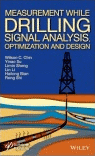 Measurement While Drilling Signal Analysis, Optimization and Design, First Edition (Wiley, 2014). Key issues in MWD telemetry - desurger distortions, signal enhancement by constructive wave interference, multiple transducer echo cancellation and pump noise removal methods are considered. Siren hardware and turbine design are discussed, as are innovative test approaches.
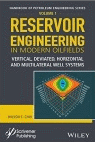 Reservoir Engineering in Modern Oilfields: Vertical, Deviated, Horizontal and Multilateral Well Systems (Wiley, 2016). Mr. Chin earned the British Petroleum Chairman's Innovation Award for reservoir engineering in 1990. This book describes rapid, accurate and stable methods for Darcy flow simulation of systems of vertical, deviated, horizontal and multilateral wells in 3D layered, heterogeneous and anisotropic formations. Wells are sketched on computer screens, constraints are specified (that may change during simulation), new laterals drilled or old ones extended, and farfield drives are defined for steady or transient analysis. Detailed results completed within minutes, with color plots and reports generated. Extremely fast graphics and numerical engines, plus a user-friendly interface, support field optimization and infill drilling needs. Special graphics boards or hardware accelerators not required to operate Windows software.
 Quantitative Methods in Reservoir Engineering, Second Edition (Elsevier, 2016). This new book updates our successful First Edition with latest developments in formation testing (exact and numerical forward simulation methods, inverse approaches for permeability prediction in high and low mobility environments, surveys of modern tools and their capabilities) and multilateral well design for enhanced production in layered, anisotropic and heterogeneous reservoirs. These two areas augment the extensive collection of math models presented in the predecessor book (described below). In addition, many concepts new to formation testing pressure transient interpretation, complex invasion and "Time Lapse Logging" are introduced.
 Quantitative Methods in Reservoir Engineering, First Edition (Elsevier, 2002). This monograph, an outgrowth of Modern Reservoir Flow, presents exact models for Darcy flows from fractures and shales, provides rigorous solutions for formation invasion with mudcake buildup, develops reservoir flow simulators on curvilinear grids, explains streamline tracing algorithms in complex reservoirs, and so on. These latter topics, covered in highly specialized courses, are presented in a "plain English, down to earth" manner requiring no more than a basic calculus background.
 Formation Testing: Pressure Transient and Contamination Modeling (Wiley, 2014). The first industry book devoted to formation testing - the author, who developed Halliburton's GeoTap algorithms for real-time permeability in tight formations, presents exact forward and inverse methods supported by two prestigious Small Business Innovation Research (SBIR) awards from the U.S. Department of Energy. Pressure transient interpretation methods are developed from first principles. "Time to clean" multiphase models support strategies needed to pump clean in-situ oil samples. The book (co-authored with CNOOC) presents a "behind the scenes" tool design tour at Asia's largest oil service company. The novel algorithms developed would later form the basis for pressure interpretation behind the Intelligent iSyringe medical imaging device described in our 2023 book Biofluids Modeling.
 Formation Testing: Low Mobility Pressure Transient Analysis (Wiley, 2015). One year after Formation Testing: Pressure Transient and Contamination Modeling appeared, major breakthroughs in real-time permeability prediction in tight zones were announced for pressure transient data with strong flowline storage effects. Such applications are particularly important to well logging in the post 1990s time frame, as highly mobile formations have become rarer in geological discovery.
 Electromagnetic Well Logging: Models for MWD/LWD Interpretation and Tool Design (Wiley, 2014). Electromagnetic tools measure phase differences and amplitude ratios between coil transmitters and receivers. Resistivities are inferred from Maxwell's equations, but analytical difficulties preclude accurate analysis - dipole, integral equation and Born approximations are not helpful because large coil fields near drill collars are complicated to model. Further, tools may reside across multiple anisotropic layers, where interfacial charge creation leads to uncertainty in relating measurements to fluid saturations. The author, who specialized in electrodynamics at M.I.T.'s renowned physics department, solves the complete problem using a new and fast approach. Accurate 3D methods such as those proposed and solved in this book would prove extremely useful to modern logging, still mired in limiting dipole models after decades of use. Unlike available models, the present complex elliptic equations are solved with modern "relaxation" methods which promise solutions within seconds in typical computers.
 Resistivity Modeling: Propagation, Laterolog and Micro-Pad Analysis (Wiley, 2016). Whereas Electromagnetic Well Logging addresses diffusive wave propagation associated with alternating currents in 3D, this volume focuses on subjects central to resistivity logging. In particular, axisymmetric A/C coil fields with multiple horizontal and radial layers, "time lapse logging" where formation properties are inferred from resistitivy changes, plus D/C design methods for laterolog and pad resistivity tools. Voltage field calculations in anisotropic media are discussed as is streamline analysis for current flow.
 Wave Propagation in Drilling, Well Logging and Reservoir Applications (Wiley, 2014). Starting with a survey of wave propagation math methods, we delve into practical petroleum applications. Half of the book is devoted to drillstring vibrations, axial models with bit bounce and drill ahead, rock-bit interaction, stick-slip effects in torsional displacements, and coupled axial, torsional and lateral vibrations.
 Borehole Flow Modeling in Horizontal, Deviated and Vertical Wells (Elsevier, 1991). This first book written by the author in 1991 rigorously models non-Newtonian flows in eccentric annuli using advanced curvilinear boundary-conforming mesh systems. The model shows why viscous stress controls hole cleaning in horizontal wells, how vertical velocity is similarly important in vertical wells and explains apparent viscosity's role in freeing stuck pipe. Models for barite sag (density stratification) correctly predict the recirculating vortex flows observed experimentally.
 Modern Reservoir Flow and Well Transient Analysis (Elsevier, 1993). This classic book adapted solutions from theoretical aerodynamics and elasticity to reservoir simulation, for example, flows past fractures, boreholes with intersecting fractures, shales and shale arrays. Exact methods for streamline analysis are presented, as are curvilinear grid approaches to modeling irregular reservoir boundaries. Steady and transient analyses are developed for well topologies from vertical, to horizontal, to multilateral.
 Wave Propagation in Petroleum Engineering (Elsevier, 1994). This work combined drillstring vibrations of advanced axial, torsional and lateral vibrations in a single model that explained numerous field observations. For example, axial models included "displacement sources" that simulated roller cone motions, while bit-bounce and rate-of-penetration effects were enabled using lab defined rock-bit interaction results. Torsional stick-slip and reversals were obtained by coupling with axial vibrations. Out-of-plane lateral displacements were simulated by including torsion (integration with axial model provided a comprehensive description for observed phenomena).
 Computational Rheology for Pipeline and Annular Flow (Elsevier, 2001). The pioneering approaches in Borehole Flow Modeling were extended in several directions. New topics included (1) pipe flow modeling in general ducts, (2) coupled velocity and temperature in bundled pipelines, (3) solids deposition modeling, (4) wax buildup in subsea pipelines, hydrate control, pipe bends, secondary flows and others.
 Formation Invasion, with Applications to MWD, Time Lapse Analysis and Formation Damage (Elsevier, 1995). That mudcake grows with "the square root of time" is assumed in drilling and well logging. But this is generally untrue. Rigorous math models, together with validating Catscan experiments in linear and radial flow vessels, reveal the effects of borehole curvature, formation permeability, mudcake composition, pressure compaction and so on. The square root model holds only for large diameter boreholes.